
270 Fields and Counting: Finding the Essence in Scotland's Varied Child’s Plans
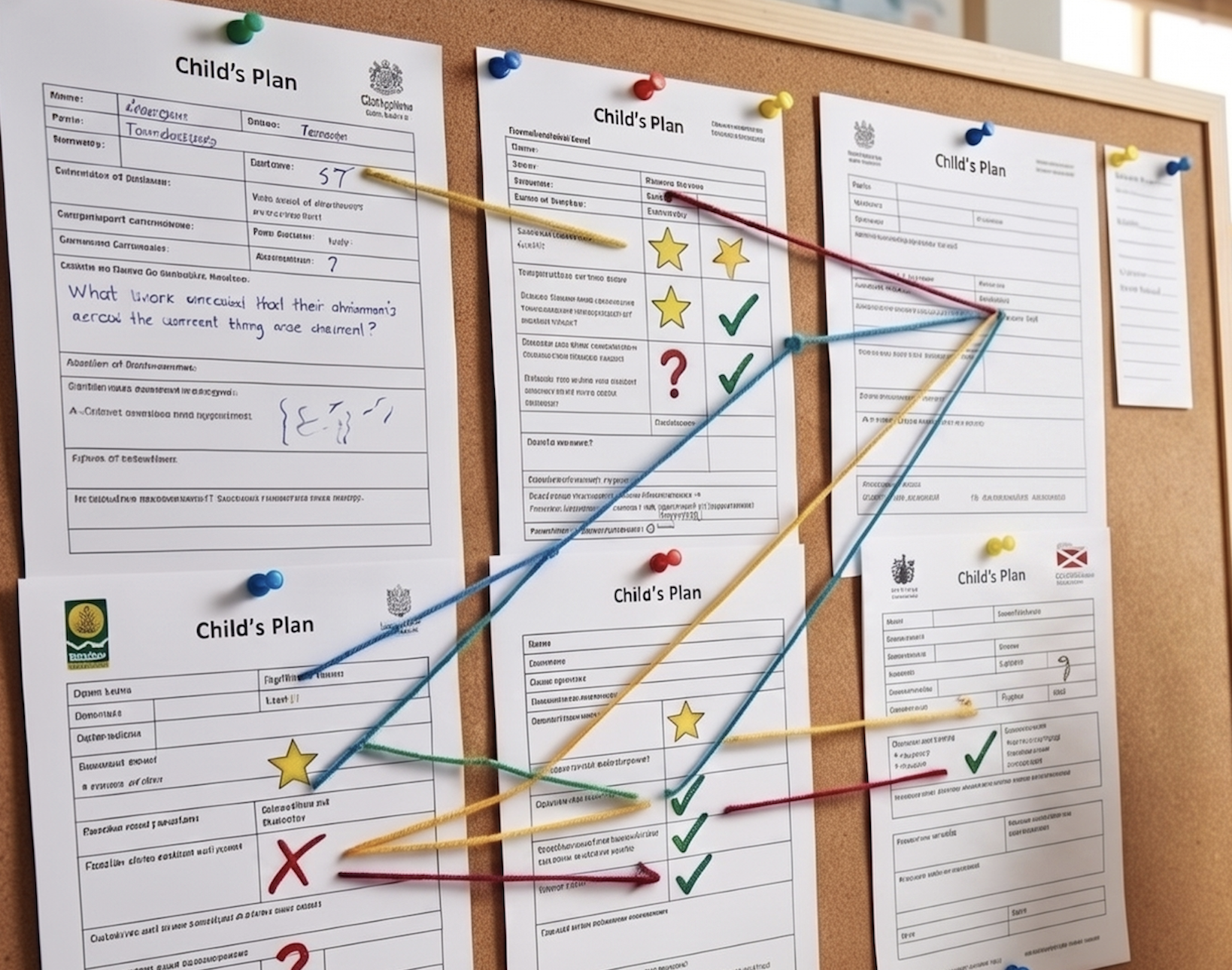
The Child’s Plan is the foundational planning document for supporting Scottish learners with Additional Support Needs (ASN). Recommended by the Scottish Government’s GIRFEC (Getting It Right For Every Child) framework, it is designed to be co-created during meetings with parents, carers, and practitioners to map out vital student support.
However, because the Child's Plan is not a statutory document, every local authority has developed its own template. In the 20 years since GIRFEC was introduced, these templates have diverged in a Cambrian explosion of boxes, text areas, and legal jargon.
At Trellis, our mission is simple: reduce the time teachers spend trapped doing admin work so they can focus on what they do best - supporting learners.
With the aim of designing a single form that works across all local authorities, we gathered 19 Child's Plan templates and created a deep-dive comparison spreadsheet. Here is what we found.
The Stark Reality of Form Inflation
Our analysis mapped out the sheer scale of variation across the country. Across the templates surveyed, we discovered a staggering 270 distinct fields being recorded.
The drop-off is stark. While a core handful of fields appear in nearly every form, 115 fields appear in only one single authority's template.

- Fields unique to only one document include: 'Scottish Index of Multiple Deprivation', 'National Identity (of the learner)', 'Address', and the 'denominational status of the school'.
- Fields appearing on just a handful of templates (3-4) include: 'Religion', 'Disability/ASN status', 'Year Group', and 'Information not to be shared'.
Every single one of these fields comes from a well-intentioned place. But cumulatively, these additions create bureaucratic sludge.
Even when different authorities use the exact same wording for a question, they can expect entirely different things. In our research, one authority's field was routinely filled out with a brief two-paragraph summary, while the identical field in another authority regularly swallowed an entire page!
The True Cost of Document Divergence
All this variation creates friction for everyone involved in a child's care:
It Burdens Teachers and Dilutes the Plan's Purpose
The templates vary wildly. Some are a concise 2 pages long, while others span 12 pages before a single piece of student information is typed. Teachers are being asked to act as data collectors, medical and social care evidence creators, legal record keepers, and verbatim documenters of parents' words - all wrapped up in a single document. When a form becomes an overwhelming chore, it stops being a useful "living document" and morphs into an admin headache.
It Confuses Parents and Moving Families
Our user research showed that families can find these documents hard to digest. As the documents get longer, they become ever more impenetrable. Given that these forms are created to support individuals with Additional Support Needs we should go the extra mile to make these documents broadly intelligible. Not to mention that this lack of standardisation also makes transitioning between local authorities incredibly difficult and confusing for families and moving educators.
It Pulls the Document in Competing Directions
The form is suffering an identity crisis. Parents often need a comprehensive historical record to secure medical or social care referrals. Meanwhile, teachers need a rapid, streamlined action plan they can refer to at speed in a busy classroom. One tool simply cannot do both perfectly.
Boiling the Child's Plan Down to its Essence
Is it possible to see the wood for the trees? Yes. By looking at what information was collected most consistently, we stripped away the local drift and found the true core of the Child's Plan.
We discovered that 84% of the plans share a highly consistent, fundamental core. At its heart, a true Child's Plan requires only:
- Learner Identity: The name and date of birth of the student.
- The Core Action Table: What we want to happen (outcomes), how we are going to get there (actions), who is taking responsibility, and the target timescale.
- Holistic Views: Dedicated space for the views of the learner, alongside the views of their parents or carers.
By focusing purely on these common elements, we force the form to become shorter, more intelligible and drastically reduce the time to complete (even before we add in Trellis’ AI draft generation).
Moving Forward with Trellis
This analysis helped us build a streamlined form that handles this core process beautifully. We know we can't capture every single field ever requested by every agency. But we are confident that by doing the core parts well, we can return valuable hours to classrooms.
We actively encourage new local authorities to adopt our optimised template when deciding to utilise Trellis in their workstream. The feedback from those who make the switch has been very positive: they don't just get the benefit of AI-powered automation, they get the old-fashioned benefit of less paperwork!
Data Geeks: If you want to dive into the full report, we would love to share it with you! Drop us a line at support@trellis.scot.

More resources
How Trellis protects pupil data

Teacher Survey results
Response to the SEND White Paper: reducing the admin burden


© Trellis Education Ltd. 2026 | Company no. 16500654
